


This article is part of the Kazakhstan Artisan Initiative, a community-based cultural sustainability initiative in the country of Kazakhstan developed through a partnership between the Center for Folklife and Cultural Heritage and the Union of Artisans of Kazakhstan. The collaboration aims to strengthen artisan networks, enhance the skills and income of artisan enterprises, and increase youth participation in craft practices. It is made possible with support from Chevron.
The booming sound of a buffalo-hide drum locks into a rhythm with a Yaqui singer’s powerful voice. Across the hall, a meal is being prepared from the same ingredients that have been grown on this land for millennia: the Three Sisters of corn, beans, and squash. An endless variety of artwork surrounds this lively gathering, drawing in a crowd of curious onlookers from deep within the Tucson Mall. Over a dozen artists from the sister cities of Tucson, Arizona, and Almaty, Kazakhstan, have assembled at Catalyst Creative Collective for a cultural exchange in partnership with the Smithsonian, the Union of Artisans of Kazakhstan, and Art State Arizona. As the song finishes, the smiles and applause don’t need a translator. Music, art, and food are the common languages today.
Yaqui singer and drum maker RickyVegas Triana leads visiting artisans from Kazakhstan in a song. Video: 7sound & Co Media Group
Though it may not be the kind of event one usually associates with a shopping mall, this collaboration perfectly embodies the purpose behind the space. The Catalyst Creative Collective, Art State Arizona’s 14,000-square-foot hub for imagination, innovation, and community connection, sits at the heart of Tucson inside the Tucson Mall. It is a truly unique venue where artists, educators, cultural groups, nonprofits, and businesses come together to weave the arts into everyday life. The expansive facility features a teaching kitchen, recording studio, gallery, and classrooms dedicated to arts education. More than twenty partners call it home, including an orchestra, culinary ventures, a dance company, a music school, and a photography studio—many of which offer free or affordable programming.
Catalyst was founded in 2019 by Art State Arizona, a nonprofit dedicated to making arts essential to everyday life for Arizonans. The organization began in 1997 as a rural arts council and has become a statewide organization supporting artists through placemaking programs, festivals, public art, advocacy efforts, and operating Catalyst as a creative community hub. When a team at the Smithsonian was exploring how to engage a new program, the Kazakhstan Artisan Initiative, with local and regional artisan communities in Arizona, Art State Arizona was one of the first organizations they contacted.
Art State Arizona turned to the Catalyst to curate a vibrant evening of music, cooking, and cultural exchange in July 2025. The purpose of this gathering was to connect Arizona’s creative community with artisans from Kazakhstan, fostering dialogue and collaboration across borders. It became a celebration of shared artistry and a powerful example of how the arts can bridge cultures and bring people together.

Notes of Tucson and Beyond
To start the event, the Kazakhstani artisans were met with a warm welcome from the Tucson Girls Chorus, who sang a beautiful rendition of the American folk song “This Little Light of Mine” and ended by shouting out “кош келдініз” (welcome) in Kazakh. The chorus recently returned from a performance at Carnegie Hall, representing Tucson on the national stage. Community engagement is a big part of their mission, and they reveled in the opportunity to connect with the Union of Artisans of Kazakhstan.
“We were overwhelmed to hear the girls welcome us in Kazakh,” silversmith Stulangali Abdireim said, adding how moved he was by the experience. “It was the first time outside of Kazakhstan that people have greeted us in our own language.”
Tucson and Almaty may be separated by 7,000 miles, but the artists found a connection by tapping into the origins of their deep cultural roots. Indigenous Yaqui singer and drum maker RickyVegas Triana immediately noticed the similarities between the flags of the two nations.
“The Kazakh flag has two primary colors—blue for water and rivers and yellow which represents the sun,” Triana said. “We have those two colors on our Yaqui flag as well. The sun is a powerful symbol because the patriarch, the father, is very strong within our language and within our ceremonies. And we are river people, so we also share a connection with the water.”
Aizhan Bekkulova, director of the Union of Artisans of Kazakhstan, presented Triana with a red shashak bau, a traditional Kazakh cord with tassels, used to decorate and hold together elements of a yurt; it is also used as a protective ornament. This gift symbolized the wish that their blood will always run rich with creativity and luck.


In exchange, Triana presented Bekkulova with a necklace and explained the symbolic meanings in its design: “The red also represents blood and sacrifice. The white represents the spirit one must have to live a good life. The circle on this necklace represents the eye of the deer, a medicine that protects us and shields our hearts from evil. The deer is the most sacred animal to us. In this way, the use of music and colors is a way of keeping our traditions alive.”
Triana considers himself an Indigenous culture conservationist. He makes a point to learn and teach songs not only from his own Yaqui traditions but from the other tribes that he travels to as well. He taught the visiting artisans “Ate Wakan Tanka,” the Lakota Sun Dance song. The Lakota word oyate (people or nation) is repeated as a prayer of healing for the community. To the Yaqui and other Native American tribes, the drums are a tool of medicine.
“The best part of humanity is rested in the ancestry that we can carry forward—not in the depletion or unremembering of those things,” Triana said. “By keeping them alive, we’re able to become stronger.”


Artists from the Tucson Handweavers and Spinners Guild shared the techniques and inspirations behind their craft. The language barrier dissolved into gestures of admiration as onlookers gathered close, studying each detail with curiosity and wonder. Weaver Maddie Tsurusaki felt an immediate kinship with Kazakhstan’s rich traditions in weaving and fiber arts. Her tapestries, which she describes as “visual diaries,” weave together techniques from around the world to express deeply personal symbols and stories.
Master Kazakh textile artist Madina Akhmetova shared her vibrant felt artworks, dyed with natural pigments and rooted in centuries of tradition. Born into an artistic family that runs a gallery and studio in Shymkent, the award-winning artist continues her lineage by teaching and inspiring the next generation.
Across the exchange, other artists showcased mixed media, jewelry, and finely tooled leatherwork inspired by traditional Kazakh attire—each piece, a reminder that creativity is a portal to understanding.
A Taste of the Southwest
An event focused on the American Southwest wouldn’t be complete without gathering in a colorful kitchen where the aromas of fresh chiles and sizzling steak fill the air.
Art State Arizona has a long history of celebrating the culinary heritage of Southern Arizona, whose rich agricultural traditions go back millennia. When Tucson became the first UNESCO City of Gastronomy in the United States in 2015, it marked international recognition of something locals had long known: this region’s food culture is among the richest and most enduring in the world.
For over 5,000 years, Indigenous communities, such as the Tohono O’odham and Akimel O’odham peoples, have cultivated the desert, growing tepary beans, squash, mesquite, and prickly pear—ingredients that continue to define the local table today. These traditions, combined with Mexican, European, and frontier influences, have created a unique culinary identity, one that Art State Arizona has celebrated for many years through its creative festival programming.
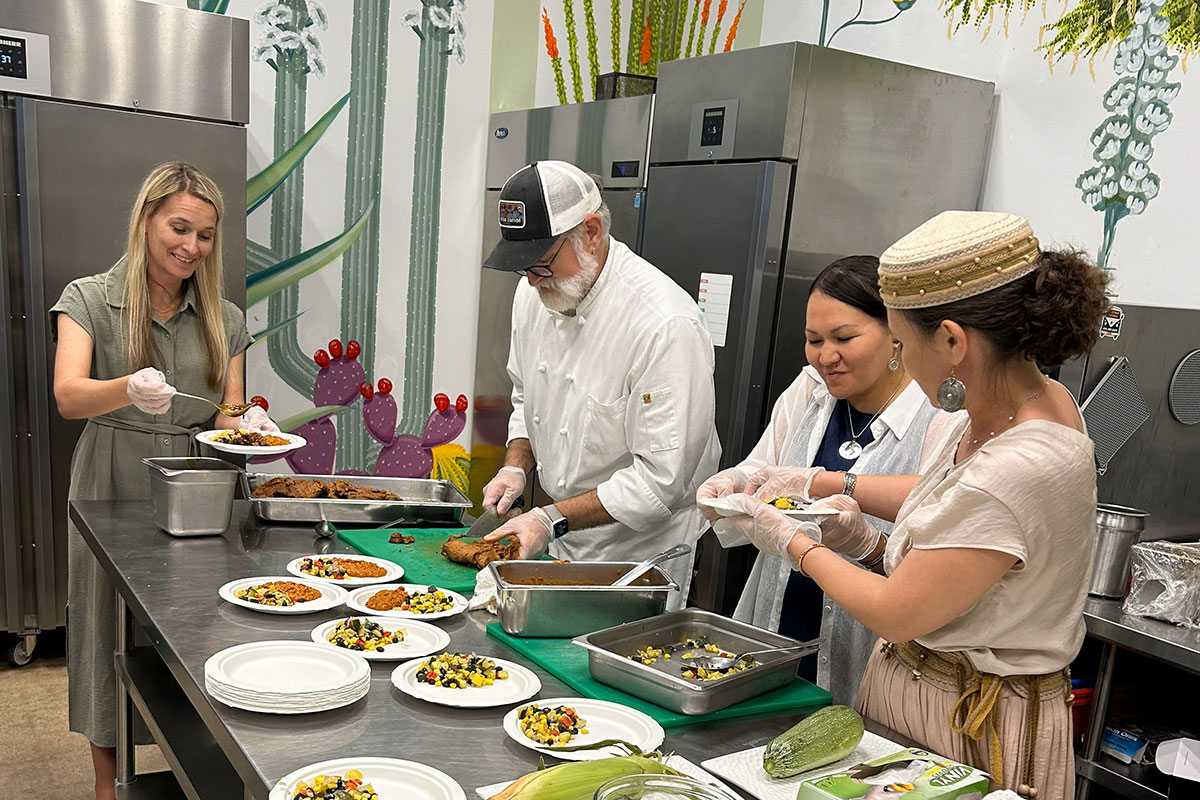
Chef Devon Sanner, one of the Tucson culinary leaders who emerged through the city’s UNESCO City of Gastronomy designation, prepared a meal for the visiting artists that celebrated the region’s local ingredients. He surprised the crowd when he greeted everyone in fluent Russian—a nod to his time studying abroad in Moscow and St. Petersburg while a language student at the University of Arizona. The moment sparked laughter and smiles and reiterated the sense of global kinship at heart of the event. Much like Tucson, Almaty has a multiethnic population, and over ninety percent of ethnic Kazakhs are proficient in Russian.
As the room settled, Sanner turned the conversation to the land and its stories, introducing the Indigenous agricultural concept of the Three Sisters: corn, beans, and squash.
“The staple ingredient is maize or corn, whose oldest discovered remains were found in 5,000-year-old pot sherds on the banks of the Santa Cruz River, just a couple of miles away from here,” Sanner said. “The corn is accompanied by beans and squash, and this combination is known as the Three Sisters. From an agricultural perspective, the corn grows out of the ground on the stalk, and it gives a base for the bean to grow. And then down on the ground, the squash grows, and the big leaves help protect the roots and keep the moisture in the soil. From a biological perspective, many Native American communities did not have livestock as a main part of their diets. By eating these three ingredients together, they got all the essential amino acids to form a complete protein.”
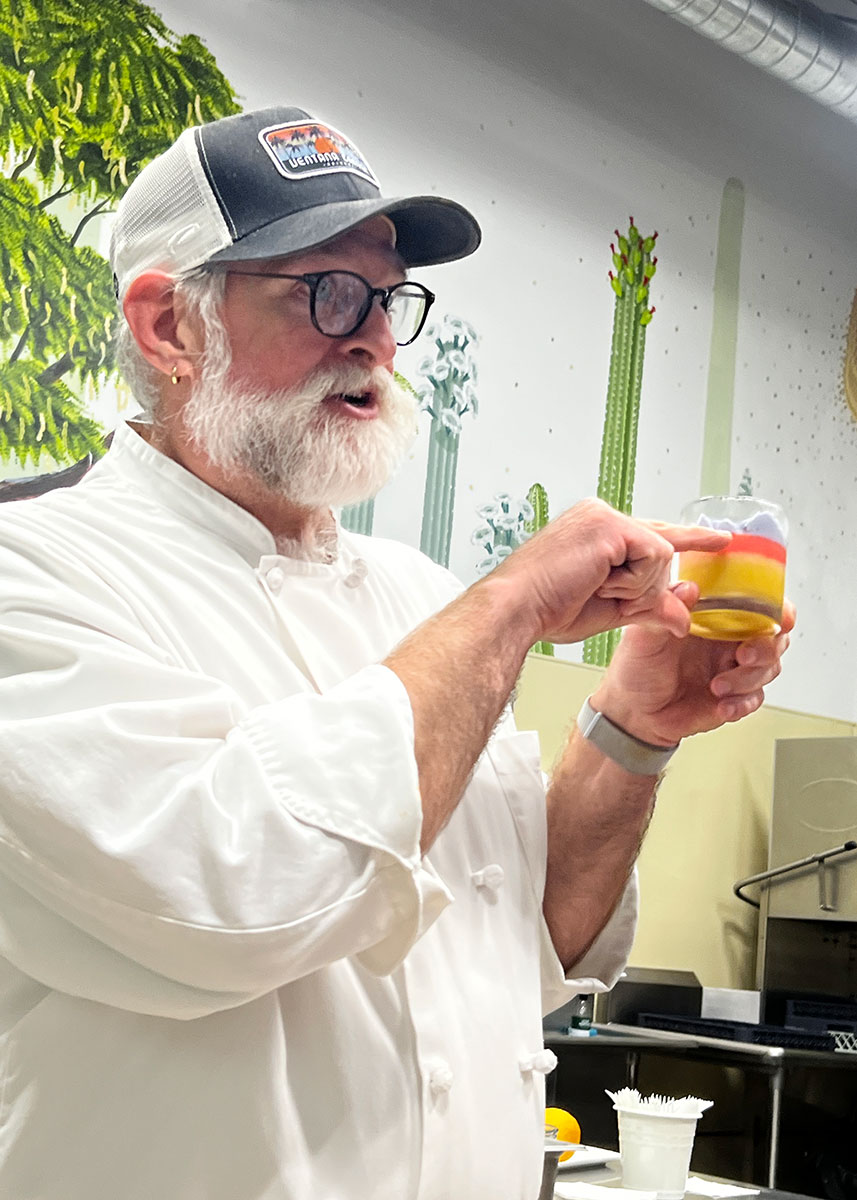
The kitchen was filled with Sonoran aromas as Sanner brought out the next course, a mesquite-cooked carne asada influenced by generations of European and Mexican ranchers. Finally, Sanner served a sweet visual feast: a Sonoran sunset represented in dessert form with layers of orange, lime, and lemon curd topped off with a pink prickly pear syrup. This offered a colorful conclusion to a creative day in Catalyst.
The artists gathered around the tables with big plates of food, sharing more stories and smiles after an art-filled day and busy travel week for the Kazakh artisans. This gathering was a reflection of what Catalyst was built for: a place where art of all mediums, created by artists of all backgrounds, converge to build community.
From textile weaving to drum songs and shared meals, the experience illuminated what Art State Arizona has long championed—that when we center creativity, we cultivate connection. And that’s exactly what makes the arts essential to everyday life. The rare opportunity to welcome such a renowned group of artisans from Almaty left a lasting impression on the Tucson community. Beyond the shared stories, techniques, music, and food, there was a reminder of something much deeper: the appreciation of humanity and the connection that comes with sharing in the gratitude of others.
Kevin Larkin is the director of Catalyst Creative Collective with Art State Arizona, where he supports hundreds of artists each year in bringing their visions to life across disciplines and communities. A sound artist, producer, and performer, his collaborative practice spans film, sound installation, dance, puppetry, songwriting, and spoken word.
